

Paper Magpie
CLEAR · The Second Reading

One for sorrow.
A magpie on a fence. The rhyme lands before you can stop it.
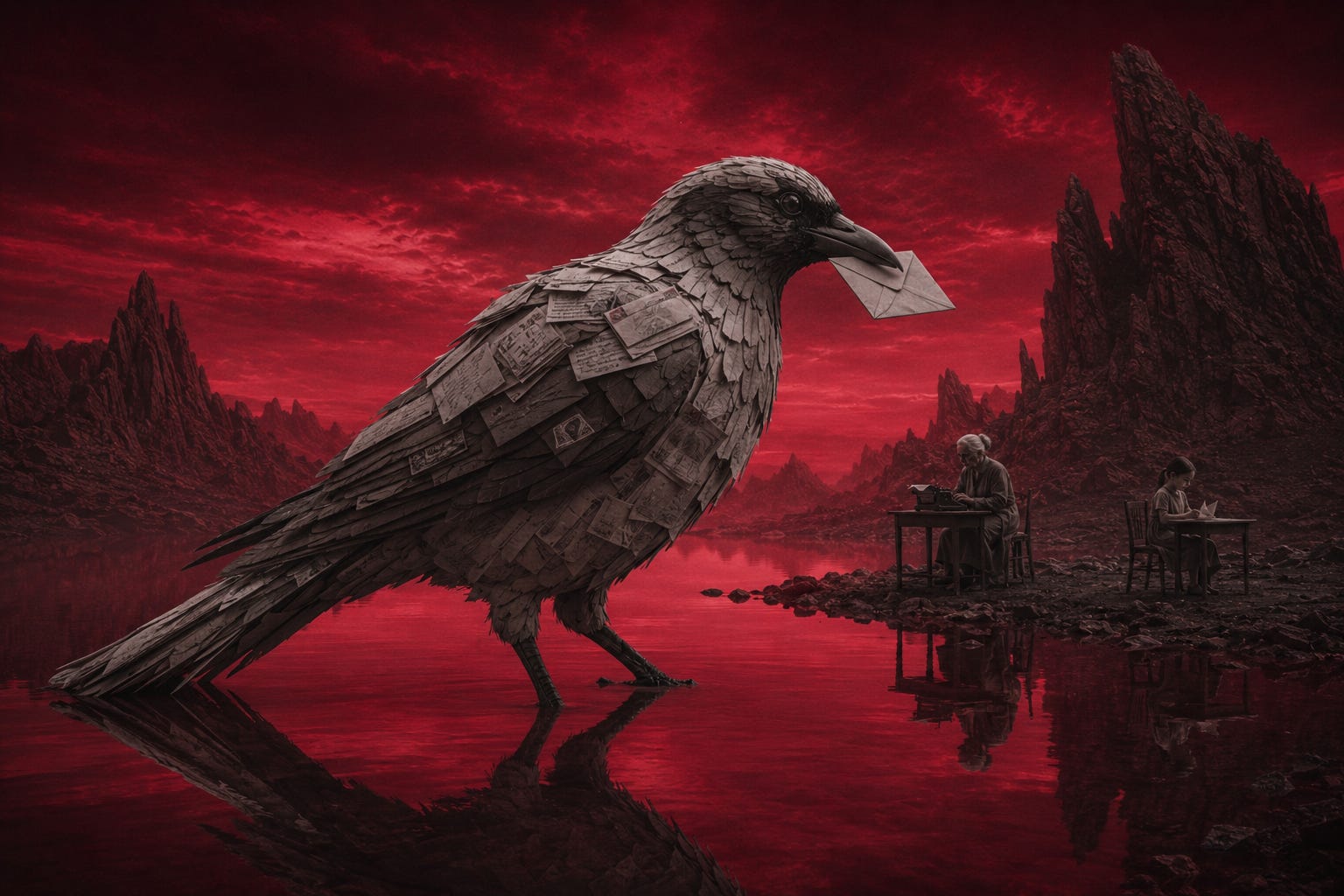
The bird was a thief, we were told. A devil in black and white. Rossini wrote an opera about a servant girl hanged for a theft the magpie committed. Noah refused it passage on the Ark, and later, when Christ hung on the cross, the magpie was the only bird that did not weep. It sat outside, chattering and swearing, and the West made it a devil for that.
None of it is true.
The Exeter study ran sixty-four field tests. Researchers placed shiny objects near magpie feeding grounds and waited.
The magpies approached twice. They discarded the objects immediately. They ate less near unfamiliar items.
The bird we built a whole cultural narrative around was afraid of the things we said it stole. Neophobia, not greed. Caution, not avarice. The first reading was wrong.
A second reading.
Magpie fledglings in groups of ten solve colour-puzzle tests in roughly a dozen tries. Those in groups of three need over thirty. Intelligence is not genetic destiny. It is social density. The smartest bird in the room is the one with the most birds around it.
A second reading: magpies hold funerals. Forty birds gather around a body, vocalising for ten, fifteen minutes. Some fly away and return with blades of grass laid beside the dead. The bird that did not weep at the crucifixion turns out to be one of the only birds that mourns its own.
The Chinese word for magpie is 喜鹊 — happiness bird. The first character is joy. In Manchu myth, a magpie drops a piece of red fruit near a heavenly maiden. The child she bears founds an empire.
In Korea, a magpie tricks a tiger and saves a woodcutter’s life. Once a year, on the seventh day of the seventh month, magpies fly to the Milky Way and form a bridge for separated lovers. The birds are the planks. The birds are the infrastructure of love across impossible distances.
Every culture on earth has looked at the same creature and seen a different bird.
The magpie is a Rorschach test.
And the first reading is almost never the truth.
My grandmother was called Dearling.
That was her name. The word on her birth certificate. Not a term of endearment. A word for tenderness, worn by a woman who did not do tenderness out loud.
She came from Guildford, loved the English heart, and lived ninety-five percent of her life in Scotland, around Aberdeen. An Englishwoman who never quite belonged to the place she lived and never quite left the place she came from. She carried the name like a secret she was willing to share but not to explain.
The first reading of Dearling: reserved.
From a different generation. She did not say “I love you.” She did not perform warmth. She was hard to reach, the family said. She doesn’t show emotion.
An English heart in a Scottish house, sixty years of not quite fitting either category. The people around her mistook the quiet for a lack.
I believed it for a long time.
The greenhouse was the first room I ever paid attention to.
Not a metaphor. A real place. The smell of the vine. The way she would watch me with my Papa as he moved through it, not hurrying, not performing, just attending. She touched things the way you touch something you intend to keep. The greenhouse was where Dearling was most herself: a woman watching my wonder and drinking in the rituals, the cuttings, her quiet.
The office was the second. The typewriter. The ink. The carbon paper. The understairs cupboard, tidy and immaculate. A woman who kept her tools the way she kept her feelings: ordered, private, ready.
I did not know I was studying.
I was just watching.
What I learned in those rooms was a language I had no name for. She at the typewriter, me with the paper. No eye contact required. No declaration. The connection was in the rhythm, in the shared understanding that the objects mattered.
Parallel play. That is the phrase now. Two people in the same room, attending to their own things, connected without words.
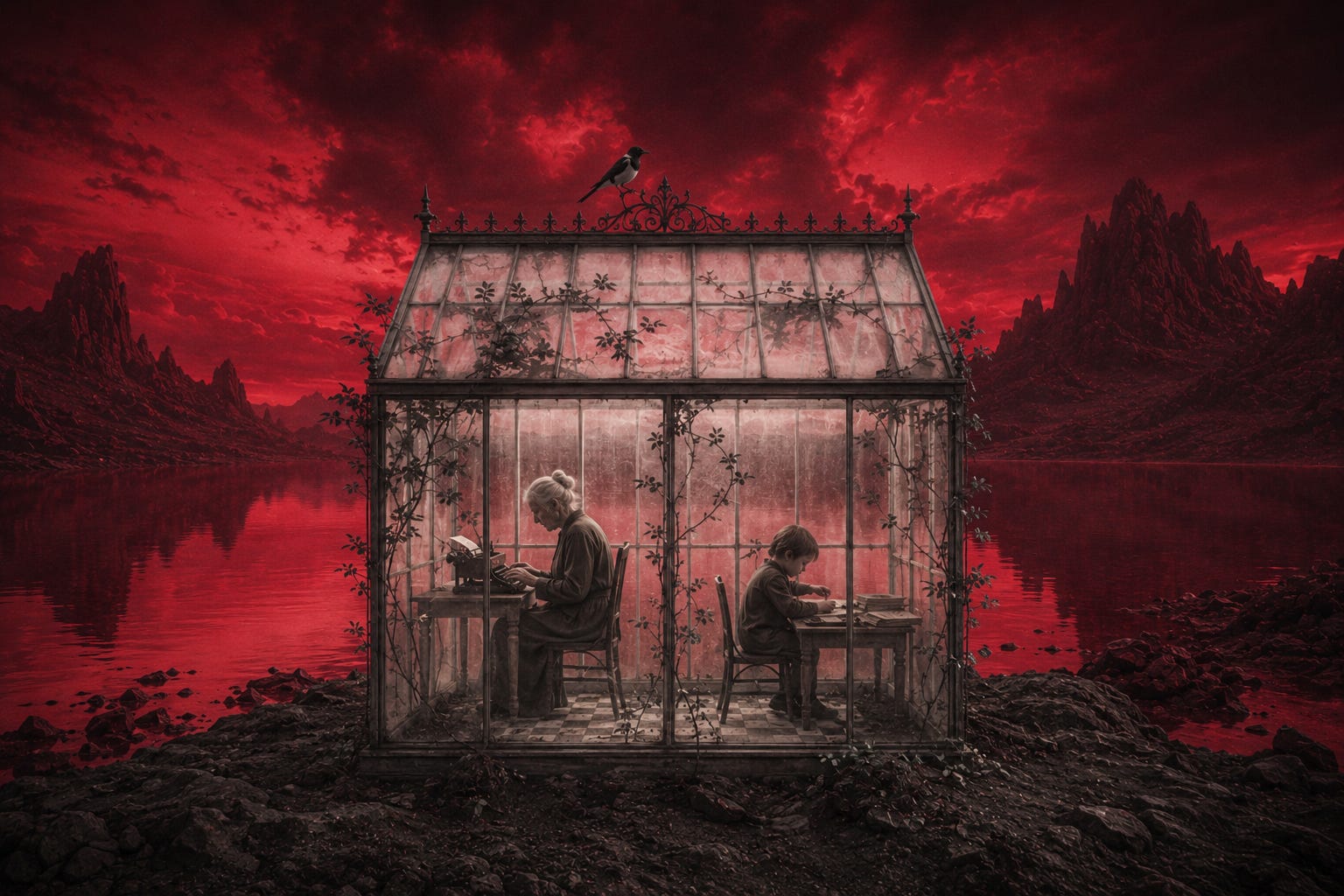
Later, I learned to feed her interest.
I sent letters. Postcards, cuttings, stamps, envelopes, odd paper. Things I had found, things I had made, things I thought she might keep. I did not send “I love you.” I did not send declarations. I sent objects, because objects were the language she spoke.
And she kept them. Every single one.
I send → she keeps → I get them back → I reflect.
A conversation conducted entirely in things. Bonding without emotion. Emotion was not her language. But the bonding happened anyway.
In Manchu myth, a magpie drops a piece of red fruit near a heavenly maiden.
The child she bears founds an empire.
She called me to learn.
Coding. Technology. A woman in her seventies, ahead of her time, phoning her granddaughter not to say she missed her but to ask how something worked. She could not say “I am interested in you,” so she became interested in the things I was interested in.
That was the love. It just did not use words.
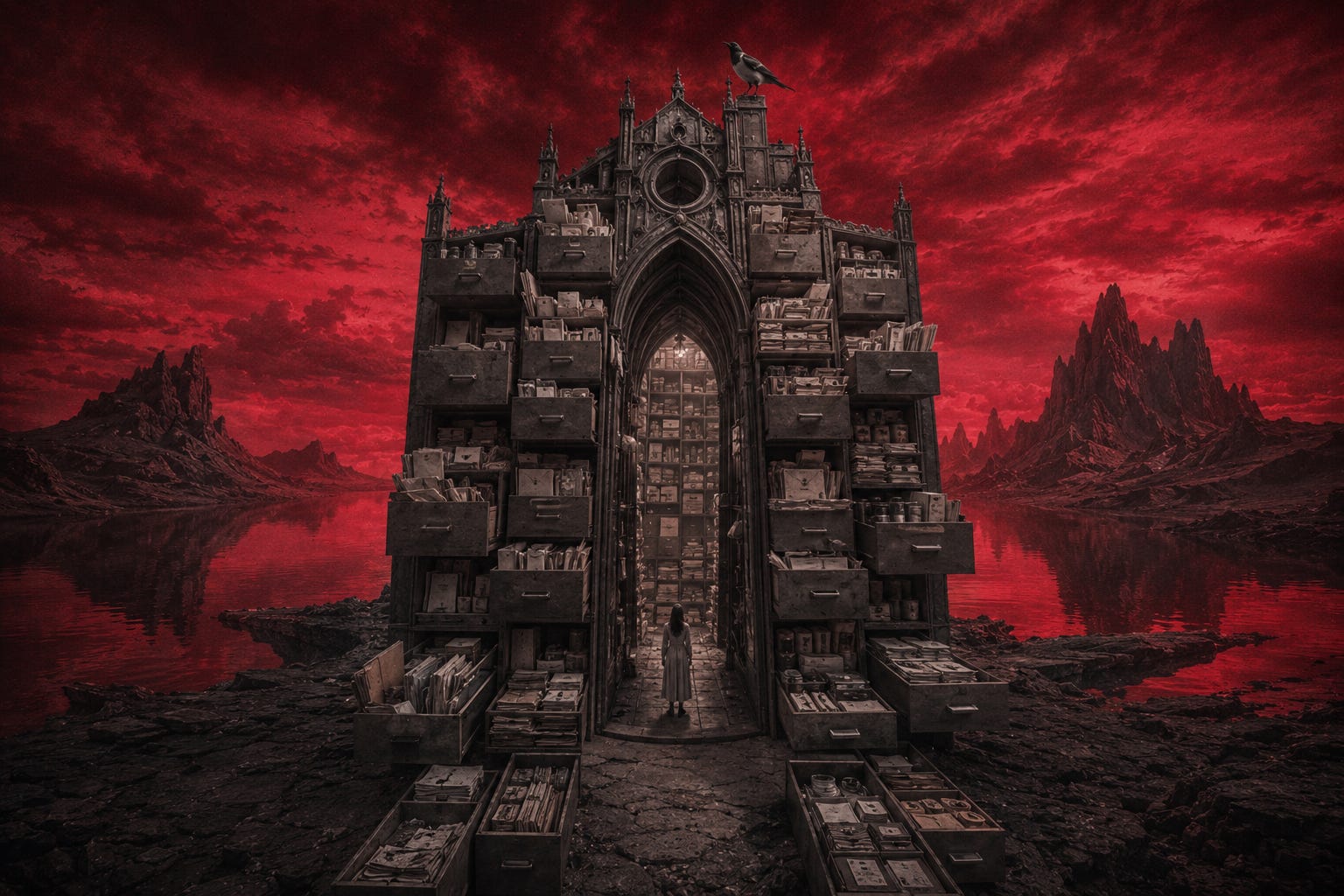
When she was gone, I found it.
The drawer. The cupboard. The box she never showed anyone. Every letter I had ever sent her. Every postcard. Every cutting, every stamp, every odd piece of paper I thought she might like.
A woman who did not say “I love you” had built a cathedral of evidence. I was standing in the middle of it.
The first reading collapsed. The second reading arrived, too late and right on time.
Her name was Dearling, and she had been one all along.
The magpie was never a thief.
The bird we misread for centuries was almost nothing like the story we told about it. The projection was the problem. The second reading is the only one that tells the truth.
Dearling was never cold. She was attending to a different register. The love was everywhere. It just did not use words.
The greenhouse. The typewriter. The carbon paper. The phone calls about coding. The stash. All of it was love, conducted in a language the world does not teach you to read.
I am still a paper magpie. Still sending things. Still keeping things. Dearling taught me how. The photograph of the three-year-old making something at the kitchen table, and the woman with the typewriter in the greenhouse, are the same line. She started it. I am still on it.
The stash outlasts the woman. The things she kept are still here. I am still feeding her interest, even now.
Sarra.
One for sorrow. Two for joy. Seven for a secret never to be told.
The second reading is the only one that tells the truth.
CLEAR is written by Sarra Richmond. She keeps a commonplace book, refills fountain pens more slowly than she needs to, and reads the old stories twice. She writes here about attention, myth, and the small practices that make a life feel attended-to.
Beyond The Read
Beyond the Read is the room behind the essay. The process, the why, the things that shaped it, the practice underneath. A small indulgence for the ones who like to reflect before they move on.
This week: how The Second Reading was actually made.
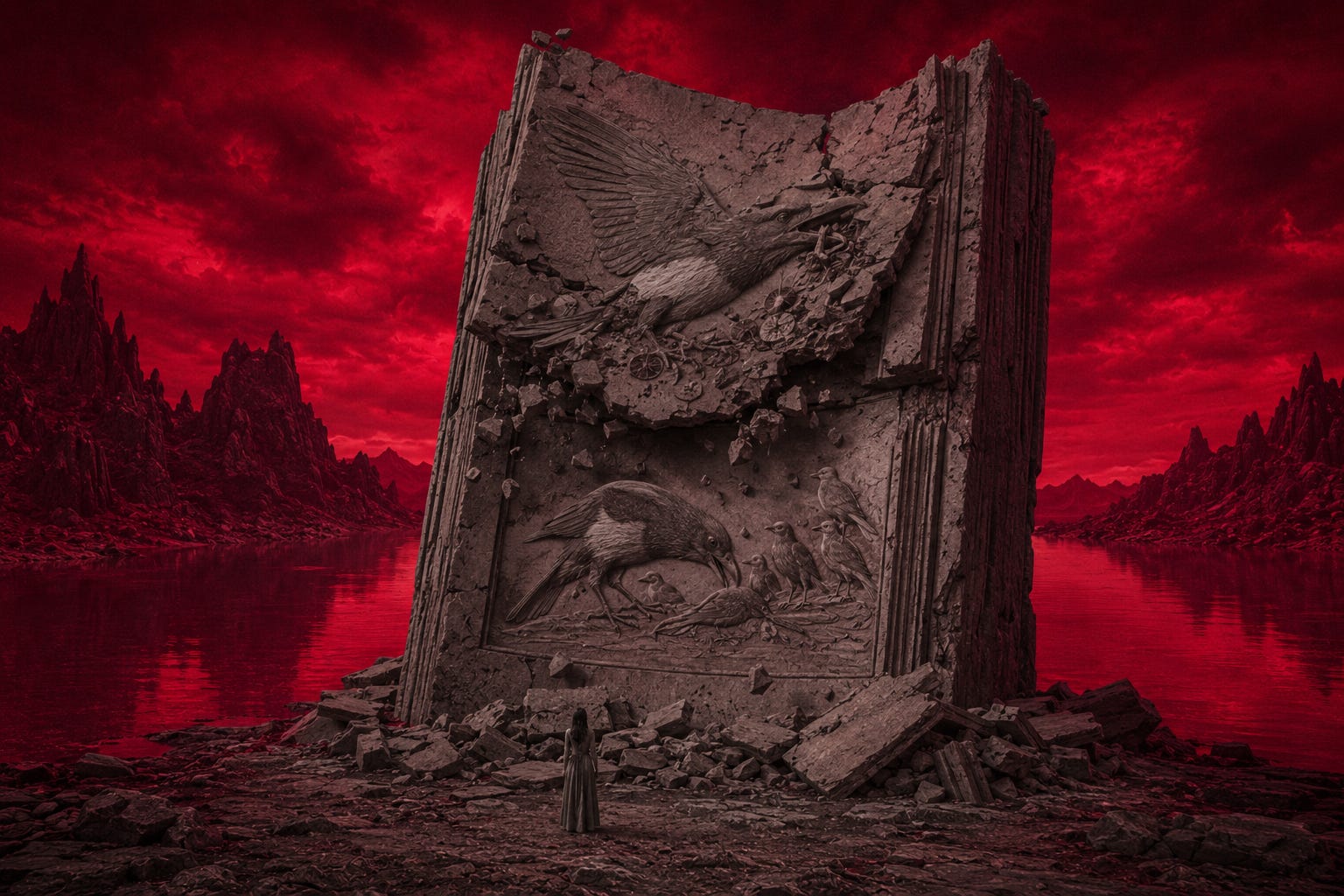
How I Prepared The Second Reading
There is a photograph I have been carrying around for weeks.
It sits inside a leather-bound journal, tucked between pages of handwritten notes. A yellow pen holds the place. Every time I open the journal to write something else, the photograph is there, and I stop.
It is not the best photograph of her. It is not even a photograph of her alone. It is a photograph of her and my papa (grandfather), holding me. The date, as far as I can piece together, is my parents’ wedding. Dearling (Brenda) and Ken (Papa), in a garden in Inverkeithing, with me in their arms.
Young grandparents. She is not performing for the camera. She is not doing tenderness out loud and that is the whole of the gesture.
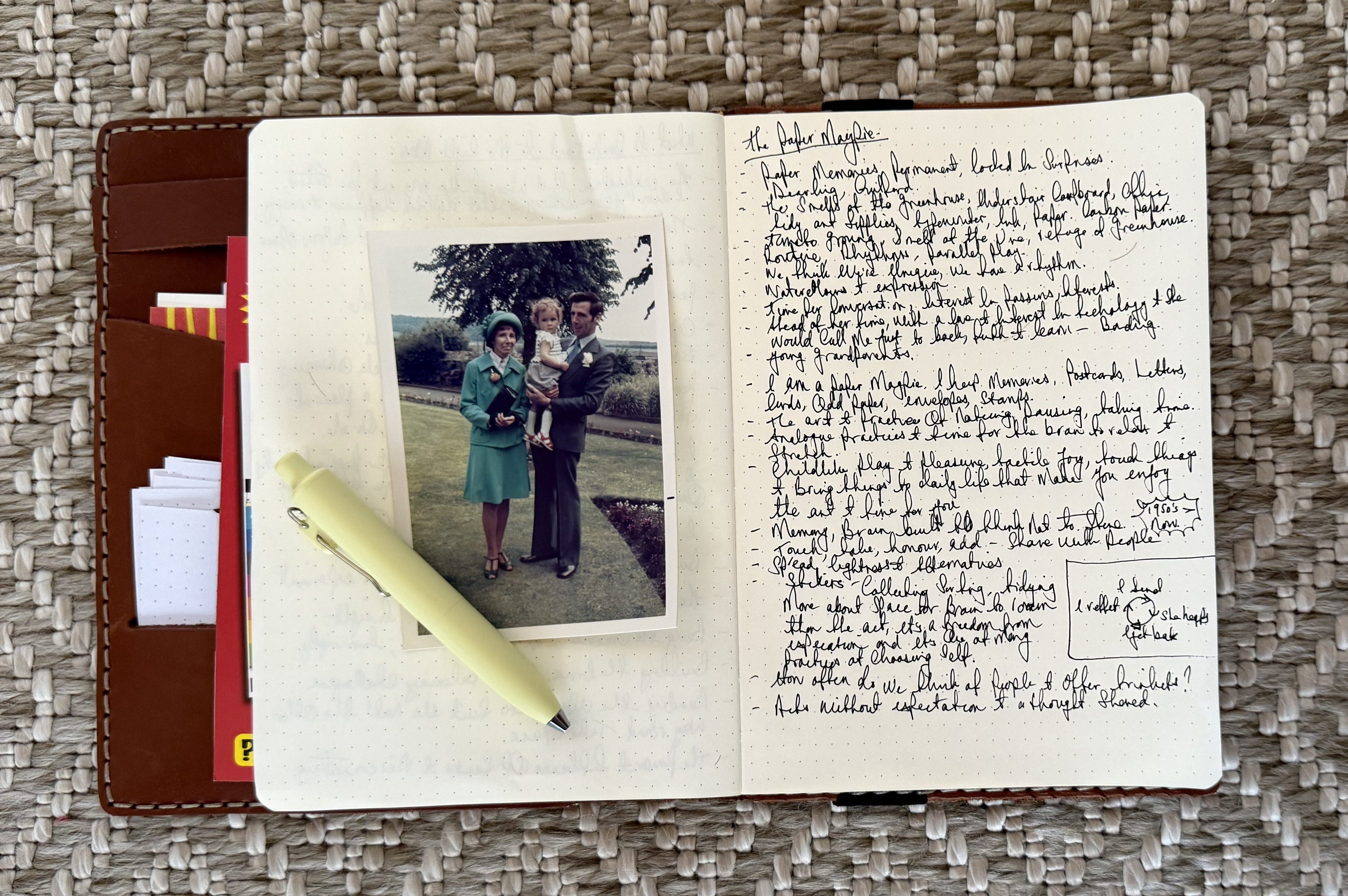
I kept coming back to this photograph while writing The Second Reading, and I want to tell you why — not because the photograph appears in the essay, it does not, but because it was the object that taught me how to write it.
The journal itself is part of the story.
I do not draft essays on a screen. Not the first pass. The first pass is always handwritten, always in this particular leather-bound notebook, always with this particular yellow pen. It is a superstition at this point, or a ritual, the two are adjacent.
Something about the friction of the pen on the page, the inability to delete, the way the handwriting changes when I am close to something versus when I am circling it. The first pages of this journal are a mess. They always are.
I started with the magpie.
Not Dearling. Not the greenhouse. Not the stash. I started with the bird, because the bird was safer. I could write about Exeter field studies and Manchu origin myths and Korean folktales without having to touch anything that hurt. The first four pages of the journal are dense with research: neophobia, social intelligence, the mirror-test controversy, the funeral ritual. I was building a fortress out of facts, the way writers do when they are avoiding the thing they actually need to write.
The yellow pen ran out somewhere around page five. I replaced it. Same model. Same weight.
The photograph was not originally in the journal.
It was in a box. The box was in a drawer. The drawer was in a room I do not go into often, because the room still smells faintly of the greenhouse: the vine, the damp, the refuge and the smell lands before the memory does, and then the memory lands and I am not always ready for it.
I took the photograph out of the box and put it in the journal because I kept needing to look at it.
The essay was not working. The magpie research was solid, the wireframes were solid, the structure was solid. But the essay had no pulse. I had written a second reading of a bird and a careful, respectful portrait of a grandmother, and none of it was alive.
The problem, I realised somewhere around page seven, was that I was still in the first reading of Dearling. I was writing about her the way the family talked about her: reserved, from a different generation, emotionally quiet. The essay was a eulogy by someone who had not yet found the stash.
I put the photograph in the journal to remind myself what I was actually looking at.
The photograph does not show a cold woman.
It shows a woman smiling. She is not looking at the camera. She is looking at me or at something just beyond me— the garden, the light, the moment. Her hand is firm. My Papa (grandfather) is beside her, doing the same thing. They are not posing. They are attending. The photograph, read the way I had been taught to read her, says nothing.
Read the way I learned to read her — the way she touched things, the way she kept things, the way she returned to things — the photograph says everything.
That was the turn.
The essay found its pulse on page nine. I stopped writing about the magpie and started writing through it. Every magpie fact became a mirror. Neophobia was her caution. The social intelligence study was her greenhouse. The funeral ritual was the stash. The Qixi bridge was the paper trail. The Chinese word for magpie — happiness bird, the first character joy — was her name. Dearling. A word for tenderness, worn by a woman who did not do tenderness out loud.
The letters came next.
I did not plan to include them. They were in the same box, in the same drawer, in the same room, and I took them out because I needed to see if what I remembered was true.
It was.
Every letter I had ever sent her. Every postcard. Every cutting, every stamp, every odd piece of paper I thought she might like. She kept them. The diagram — I send, she keeps, I get them back, I reflect — is not a metaphor. It is a description of the evidence.
The letters are not in the essay either. But they are why the essay exists. They were the proof that the first reading was wrong. The second reading arrived, too late and right on time, in a drawer in a room that still smells faintly of vine.
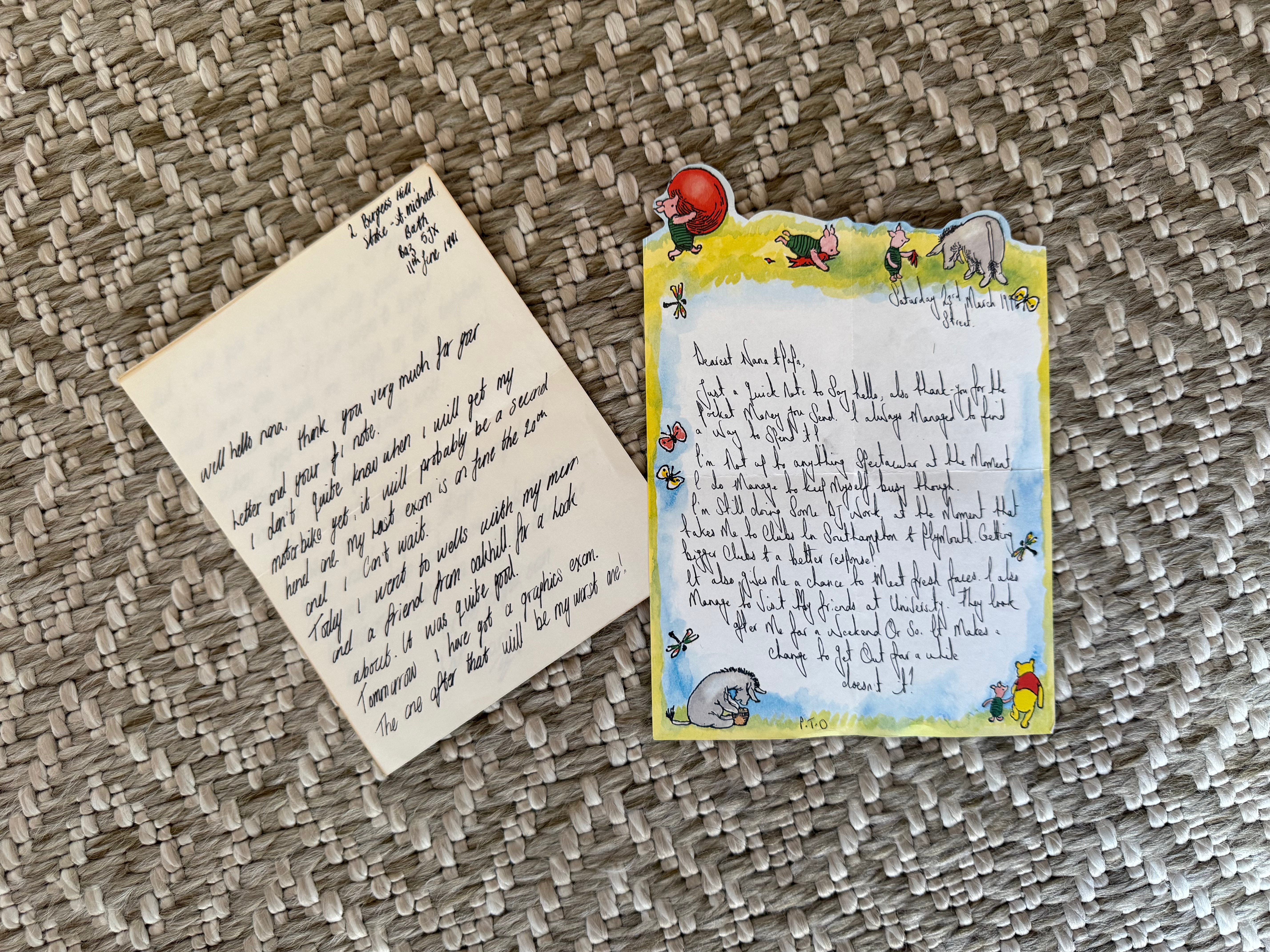
1991 (16) & 1996 (21), I have been a lifelong letter writer and storyteller, it’s a mood boost.
This is the part I cannot prove, but I will tell you anyway.
The photograph was taken at my parents’ wedding. I am too young to remember it. Dearling is too young in it, young grandparents, and that is exactly right. She is much younger than I am now. She is with her grandchild who cannot yet articulate, and she is attending to me the way she attended to everything: quietly, completely, without performance.
Decades later, that grandchild would sit at a desk with a yellow pen and a leather-bound journal and a photograph that had outlasted both of the people in it, and try to write about what it meant to be loved by a woman who did not say “I love you.”
The essay took three weeks, four wireframe sets, ten Dearling-centred outlines, two full drafts, and a publishing package built to the same blueprint as an essay about Sisyphus.
The photograph took three seconds. And it taught me more than any of the rest.
I am still a paper magpie. Still sending things. Still keeping things. Dearling taught me how.
The photograph is back in the journal. The yellow pen has been replaced again. The essay is finished, or as finished as anything ever is, and it is called The Second Reading, and the second reading is the only one that tells the truth.
The stash outlasts the woman. The things she kept are still here. I am still feeding her interest, even now.