

The Boy Who Saw Too Clearly
The Second Reading

The fields went dark, and the train window turned into a mirror.
My own face arrived in the glass, faint and floating over the passing black, a cup of cooling coffee held somewhere near my chin. For a mile or 2 I watched her instead of the countryside. She was good company, this woman in the window. She lifted the cup when I lifted it. She tilted her head when I tilted mine. She agreed with absolutely everything.
Then the train slowed for a lit platform, the real world came back in oranges and yellows, and she vanished the way she always does. The moment there is something actual to look at, the reflection has nothing left to say.
I thought about Narcissus before I thought about the window. That is usually how the old stories arrive: sideways, uninvited, and only later do you notice they have been describing your Tuesday the whole time.
I. The story, told again
Here it is, in case it has been a while.
It begins, as these things do, with somebody else’s marriage. Hera, queen of the gods, was being kept entertained by a mountain nymph called Echo, who could talk and charm and spin a story out of nothing. What Hera did not know was that the stories were a decoy. While Echo held the queen, Zeus was off among the other nymphs, doing what Zeus did. When Hera worked it out, she could not touch her husband, so she silenced the messenger instead. From that day, Echo could no longer speak her own words. She could only repeat the last thing another person said.
Elsewhere in the same woods walked Narcissus, the beautiful son of a river god, so lovely that admirers followed him in crowds and left broken-hearted, because he wanted none of them. At his birth a seer had handed his mother a riddle: the boy would live a long life, but only if he never came to know himself. Nobody could make sense of it. They filed it away, the way you file a thing you will understand too late.
Echo saw him and was lost. Unable to begin a sentence, she could only follow, and wait for him to speak so she could hand his words back softened. When he finally called out, “Who goes there,” all she could return was “there.” When he said, “I would rather die than have you love me,” all she had was “love me, love me.” He left her in the trees. Her body wore away with the grief of it until only the voice remained, the part of her that had never been allowed to be her own, carried off by the wind into caves and empty clearings.
She was not the first to break on him. A rejected young man named Ameinias had already prayed to Nemesis, the goddess who settles accounts, that Narcissus might one day feel the exact weight he handed out. Nemesis heard. She waited until Echo faded, decided that was enough, and led Narcissus to a clear, glassy pool.
He bent to drink, and met a face.
He had never seen himself before, not really, not with such clarity. He spent the day learning every angle of it, the evening watching it by moonlight, the night sleeping with his fingers grazing the water so as not to lose it. When he reached, it reached. When he leaned to kiss it, it tilted up to meet him. When he tried to hold it, it broke into rings and was gone, and came back, and broke again. He ate nothing. He drank nothing. His neck ached from the bending and his legs took root in the grass, and when the nymphs finally came looking, all that was left of the most beautiful boy in the world was a small white and yellow flower, leaning out over the water, still trying to see.
II. The line that will not let go
Ovid, who tells it best, gives Narcissus one line at the pool that I have never managed to put down.
Inopem me copia fecit.
My plenty has made me poor.
Say it plainly and it is almost unbearable. Here is a boy who finally has the one thing he has withheld from everyone else, his whole attention, his whole love, and it is aimed at himself, and it is starving him. He is not poor because he has too little. He is poor because he has all of himself and nothing else. The abundance is the famine. The having is the losing.
III. What it encodes
We hand this story to children as a warning against vanity, which is a shame, because vanity is the least interesting thing in it.
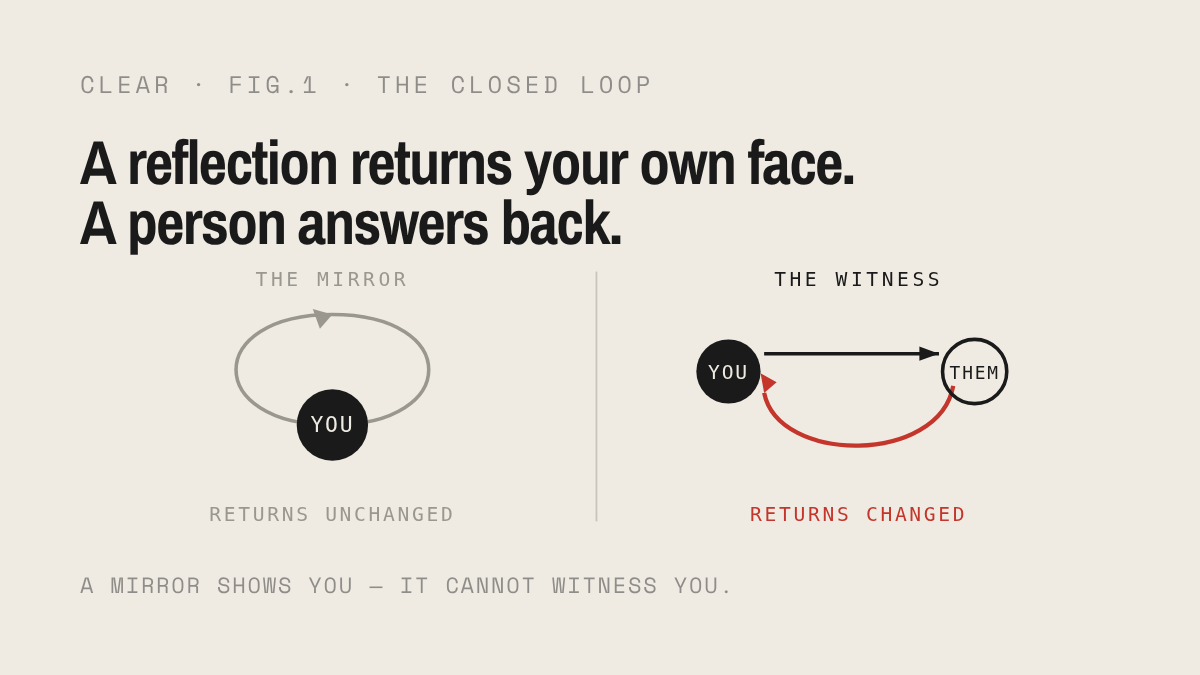
Read it a second time and it is not about loving yourself too much. It is about the difference between a reflection and a relationship.
A reflection gives you back only what you bring to it. This is the whole of its nature. It cannot surprise you, because it has no news. It cannot refuse you, because it has no will. It cannot change you, because it is already exactly you, a quarter of a second behind. You can look into it for a hundred years and come away with your own face and not one idea you did not walk up with. Call it the closed loop: attention that leaves you, travels nowhere, and returns to its source unchanged.
Now the riddle unlocks. The seer said Narcissus would live only if he never knew himself, and we hear a paradox, because surely knowing yourself is the good and difficult work of a life. But look at the kind of knowing the story actually offers him. It is knowing-as-reflection. Seeing. Not knowing-as-being-known.
And Echo is the proof, standing right there in the first half so we do not miss it. She loved him truly and all she could give was his own words handed back. Even her love reached him as an echo. He could not tell it apart from the sound of himself, so he let it die in the trees. The tragedy is not that no one loved Narcissus. The tragedy is that he had arranged his life so that nothing could reach him except more of himself.
I will say the quiet part, since the brand on this letter is a word for seeing well. Clarity about yourself is worth having. But clarity is a mirror’s gift, and a mirror only shows. It never witnesses. To be witnessed you need someone in the frame who is not you, who can look back, and disagree, and hand you a sentence you would never have written.
IV. What I did with it
I know the closed loop from the inside, because I spent most of a winter in it.
I have kept a commonplace book for 11 years, and a daily note for longer, and somewhere in a low stretch a few years ago I got the two of them confused. I stopped copying other people’s lines and just reread my own. Journal after journal, looking for myself, looking for a pattern that would explain me to me. It felt like depth. It felt like the serious inner work you are supposed to admire. What it actually was, I can see now, was Narcissus at the pool, bent over my own reflection, waiting for it to tell me something it did not have, getting quietly frailer on a diet of my own face.
What broke it was small and I nearly missed it. One grey afternoon I copied a single sentence from a novel into the commonplace book, a stranger’s sentence, one I did not fully agree with and could not have produced. It sat there on the page in my own handwriting, in words that were not mine, and it would not leave me alone. I went back to it for days. It argued with me. It changed a small thing in how I thought, which is the one thing all my own pages, for all their honesty, had never once done.
That is the difference between the two books, and it took a Roman poet and a drowned boy to show me. The daily note is a mirror. It gives you back your own days, and that is a good and worthy thing. The commonplace book is a witness. You fill it with voices that are not yours precisely so that something in the frame can look back at you. One reflects. The other relates.
Narcissus never kept a commonplace book. He had a pool, and the pool only ever showed him Narcissus.
Keep this
To see yourself clearly is worth a great deal.
To be seen by someone else is worth your life.
If it calls to you this week, try one small thing. Copy a single sentence into a notebook, by hand, that you did not write and would not have written. Something a little foreign to you, a line you half disagree with. Set it down in your own hand, in words that are not yours, and leave it there.
Then over the next few days notice whether you go back to it. That returning, that small argument with a voice from outside the loop, is the one thing the clearest pool in the world can never give you.
Sarra.
The train got in late. The window gave me my own face the whole way home, and not one new thought in it. The notebook, when I opened it on the kitchen table, gave me a stranger’s sentence. And then it gave me 3 of my own.
CLEAR is written by Sarra Richmond. She keeps a commonplace book, refills fountain pens more slowly than she needs to, and reads the old stories twice. She writes here about attention, myth, and the small practices that make a life feel attended-to.