The one skill AI makes worth more, not less
It is not writing. It is the thing I do for six of the seven steps before a word goes down. Four ideas, and how to run each one on your own posts this week.

Nobody seems to know what skill to learn any more.

AI? Prompting? Coding, before the coding gets done for you? Do you start a Substack, or is that already crowded? Do you niche down hard, or will the niche be gone in eighteen months? There has never been more opportunity, and it has never left more people frozen on the starting line, certain that whatever they pick will be pointless by Christmas.
So let me hand you the one that does not expire. The meta-skill, the one that makes every other skill you own sharper the day you get better at it.
It is listening.
And the joke of the moment we are in, the actual punchline, is that the machine has just made it the most valuable skill on the table, not the least. Everyone is bracing for AI to take the thing they do. Almost nobody has noticed it can only take the part that was never the hard part.
I know this because I get paid to do a job that looks, from the outside, like typing. Let me tell you how much of it actually is.
Somebody asked me last week how long a post takes. They meant the writing. The minutes at the keyboard. And it is a fair question, because from the outside that is the whole of it. A ghostwriter is a pair of hands. You hand over the mess, the hands hand back the tidy version with your name on the top.
So, straight answer. Eleven minutes.
That is how long the typing takes, on a good week, for a post that sounds so much like my client their own mother would swear they wrote it. Eleven minutes, because by the time I open the document there is nothing left to decide. Every real decision got made before, in the part nobody watches and nobody puts on an invoice. The part that is not typing at all.
And before I give you the four things that fill the other six steps, I should tell you I turn work away.
Sounds mad. Bear with me.
I say no when I can hear, inside the first ten minutes, that someone wants a louder version of the safe thing and not the true thing. You cannot ghost a voice you do not believe in. The work goes hollow the second you fake it. Sit with what that means. If the job were typing, I would never turn down a paying soul, because typing is typing and money is money. I turn people away on the strength of what I can *hear*. That is the whole tell. The job was never the words.
Four things. One idea at a time, and a thing you can go and do with each of them this week.
Announcement (skip this bit if you only came for the essay)
I run a thing called a Vibe Check. Short, free, and not a sales call wearing a lanyard.
You walk out of it knowing something about your own voice you did not know walking in, whether or not we ever work together. No clock on it. I do not do “this price disappears Friday,” because the price is the price and the door is always the same width.
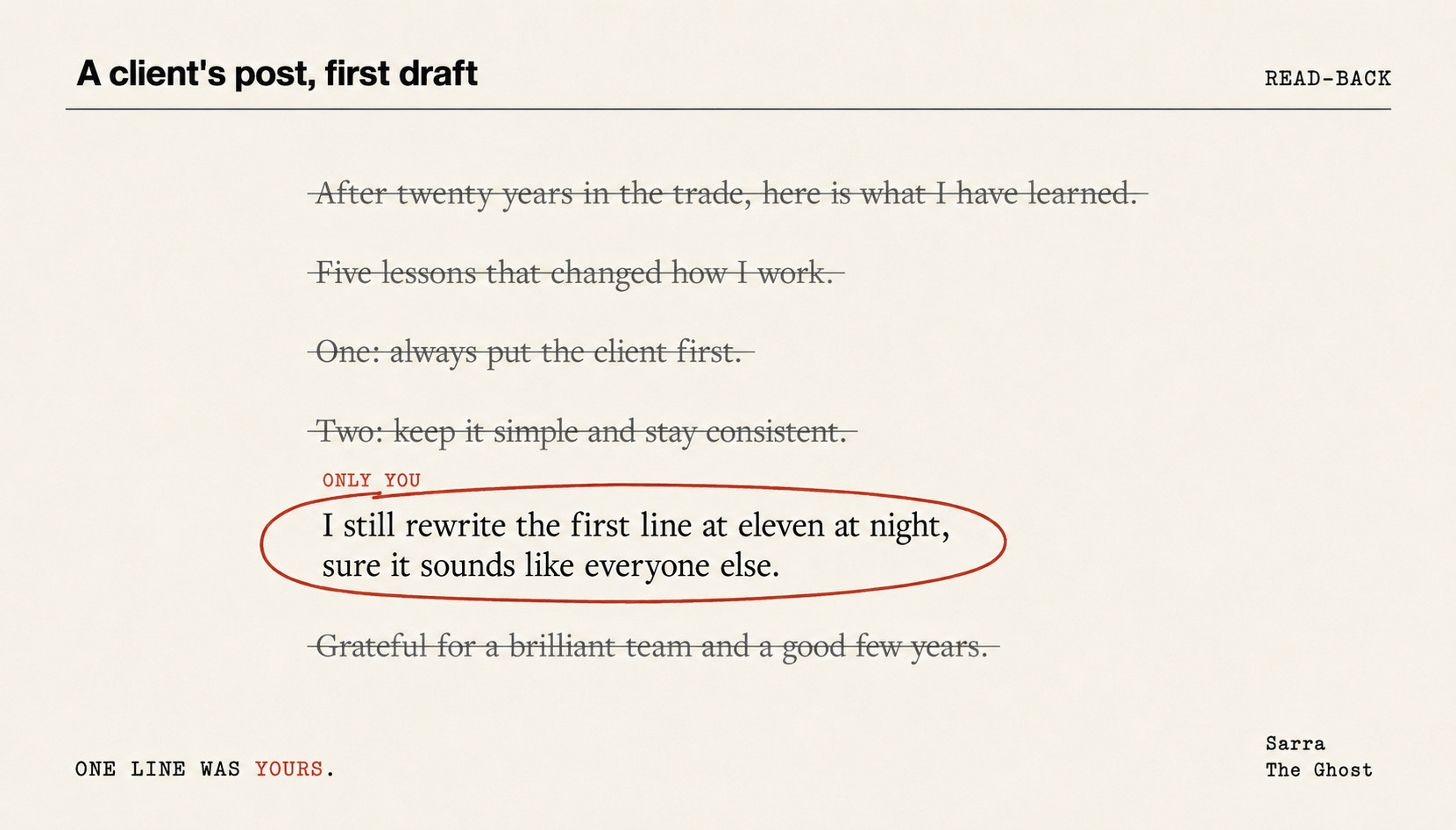
There is also a free read-back at the bottom of this letter. Keep reading, it is there at the end.
Idea I. The listening is the job
“Most people do not listen with the intent to understand. They listen with the intent to reply.”
Stephen Covey
Let me give you my definition, because the word gets used loosely and I mean it hard.
Listening is holding your own cleverness still long enough to catch what the other person actually means, especially the part they have not worked out how to say yet.
Almost nobody does it. The whole feed runs the other way. Everyone is waiting for their turn to talk, loading the next hook, the next take, the next clever reply, while the person in front of them is still mid-sentence. That is not listening. That is queuing.
There is a school of thought, loud right now, that says the meta-skill is mastering human nature. Learn the levers, learn the tensions, learn what makes people tick, and pull on them until you get what you want. And there is truth in the study. But the ethos has it backwards. The most valuable move in the room is not pulling a lever to get what you want. It is shutting up long enough to hear what they mean, and wanting that more than you want your own next sentence. Do that and the influence takes care of itself, because a person who feels heard will follow you anywhere. You did not pull a lever. You just stopped talking over the answer.
Try this on your own posts this week. Before you write the next one, do not ask “what do I want to say.” Ask “what have I actually caught myself saying out loud, to a mate, in the pub, that I would never dare type.” Write that down first, in the exact words you said it. That sentence is your hook. It was always going to be better than anything you could construct, because you did not construct it. You overheard yourself.
Idea II. The judgement is the job too
“The art of being wise is the art of knowing what to overlook.”
William James
There is a version of ghostwriting doing the rounds right now that I want to be fair to, because a real instinct is buried in it and the instinct is right.
The research-stack ghostwriter. Seven steps before a single line, and it looks serious. Inhale the onboarding form. Run the deep-research prompt. Turn the brief into a podcast for the car. Scour every post they ever published. Map the industry. Map the competitors. Read the website page by page. Then study the five loudest voices in their space and measure them against it.
Whoever built that has learned the thing most of the field will not. The real work happens before the words.
They are just aiming the whole apparatus at the wrong target.
Every one of those seven steps researches the market. The space, the vertical, the competitors, the category. Not one of them researches the person. And the person is the entire job, because I am not writing a post about their industry. I am trying to sound like one specific human being, and there is no competitor analysis on this earth that tells me what she sounds like at her own kitchen table at half past ten at night.
This is where judgement earns its keep, and it is a skill, not a mood.
Judgement is knowing, out of forty true things about a person, which one matters this week. That is the whole game. A good listen hands you forty threads. Forty real, usable, true things. Pull the wrong one and you get a post that is accurate and dead. Pull the right one and someone stops scrolling because it felt like you had been reading their diary. The gathering can be automated. The choosing cannot. Choosing is the job.
Try this. Take your topic and write down forty true things you could say about it. Fast, ugly, no editing. Then do the hard bit, which is not adding a forty-first. It is crossing out thirty-nine. Keep the one that would make the exact person you want to reach feel slightly exposed. Ship that one. The discipline of the cut is the entire craft, and it is the part no tool will do for you, because a tool does not know which of the true things costs you something to say.
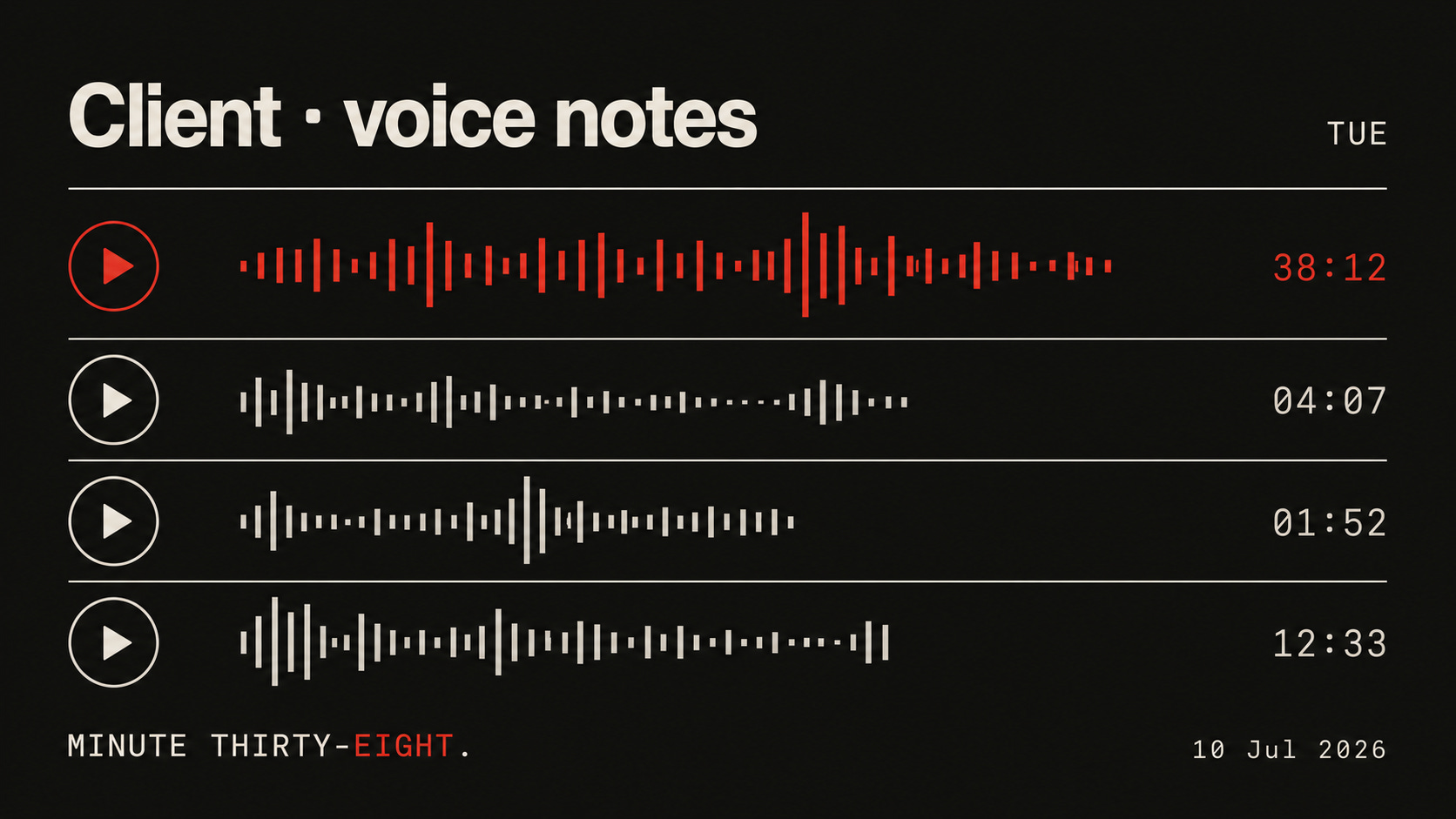
Idea III. The gold is in what they do not say
“The most important thing in communication is hearing what isn’t said.”
Peter Drucker
Now the part I could talk about all day.
The brief is the rehearsed version. Tidy, useful, and about as revealing as a CV. The gold is never in the brief. The gold is in the swerve.
Three places I go looking, every time.
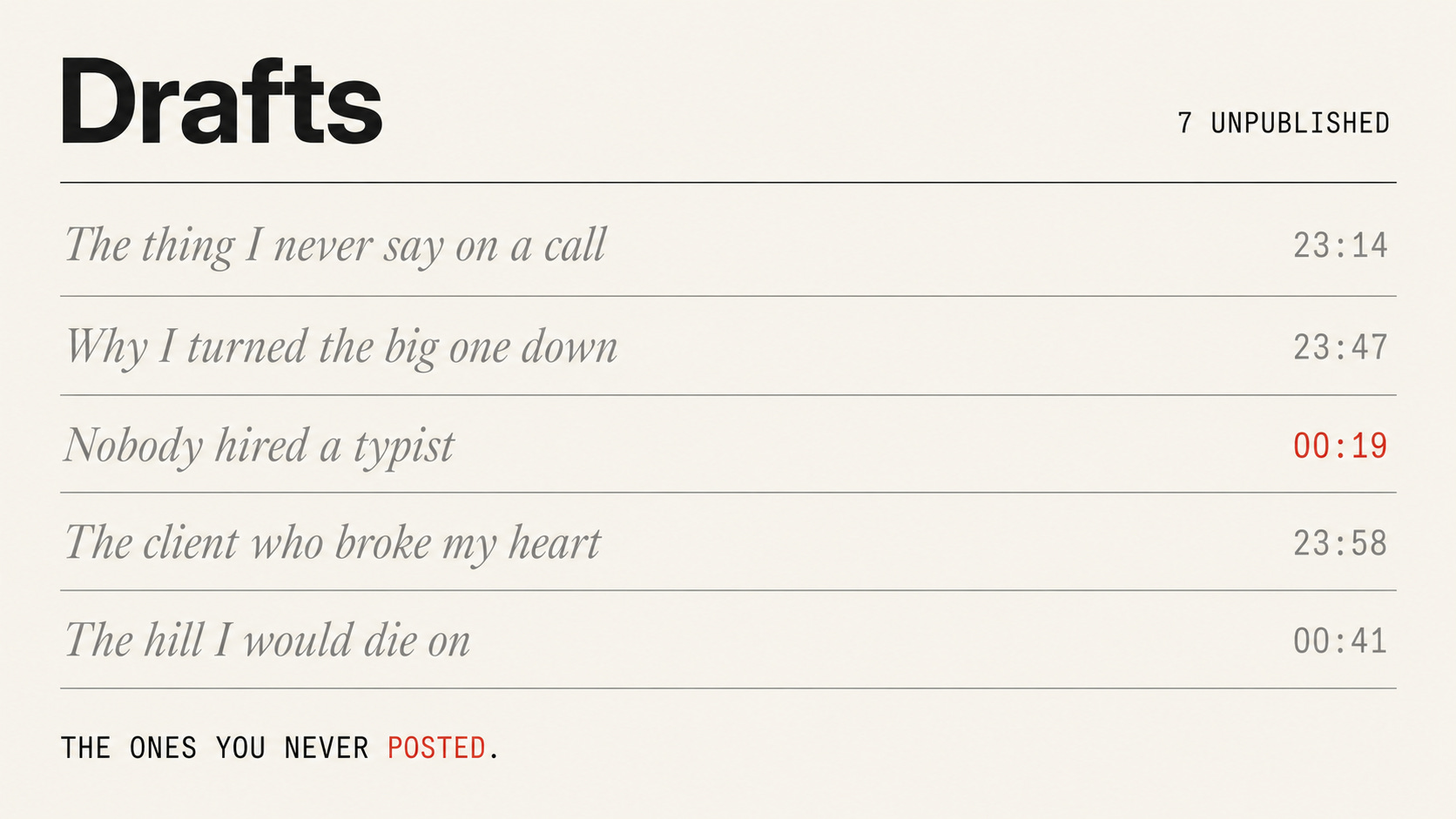
The drafts they never published. The posts written at eleven at night that they could not press send on. That folder is where the real voice lives, frightened, with the light off. It tells me more in five minutes than the whole public feed does in a week, because the feed is what they were brave enough to post and the drafts are what they actually think.
The sentence they start and abandon. There is a thing in psychology called the Zeigarnik effect, the way the mind will not let go of an unfinished task, keeps worrying at it, keeps it lit. Half-finished sentences work the same way. People hedge hardest around the exact thing they most need to say, and the sentence they cannot finish is the one nagging at them the loudest. The abandoned half is not noise. It is a map with a great big X on it.
And the rooms. The client who broke their heart. The meeting they walked out of. The hill they would die on and have never once written down. A voice is not a stack of adjectives off a brand worksheet. It is scars, and you cannot borrow a person’s scars off their competitors’ LinkedIn.
I know I have got there when I read a line back and their face goes still. Not “that’s good.” Quiet. The quiet of someone meeting a version of themselves they had been told to keep off the timeline, working out they were allowed to sound like that in public the whole bloody time. Nothing on a dashboard tells me that. You have to be in the room, watching the face.
Try this. Open your own drafts folder. Find the post you wrote and never published. Do not fix it. Just ask yourself the honest question of why you did not press send, and write about that. The reason you were scared to post it is almost always the most interesting thing you have. The fear is the tell. Follow the fear.
Idea IV. Your ear is your niche
“The dignity of movement of an iceberg is due to only one-eighth of it being above water.”
Ernest Hemingway
This is the idea the other three were built to reach, and it is the one that matters most right now, in July 2026, with the feed still arguing about whether the machine is coming for this craft.
Let me settle it. It can type. It types faster than me, it never gets tired at eleven at night, and it will run that entire seven-step research stack in a fortnight of quiet afternoons and hand you a competitor map that would take a person a week. Fine. Let it have the typing. Let it have the market research too, the whole clever fucking apparatus of it.
It cannot be in the room.
That is the eighth of the iceberg that never shows, and it is the eighth holding up the other seven. Hemingway’s whole point was that you can only leave a thing out on purpose if you actually know it. The power of the unsaid depends entirely on the writer having been there. The machine has been nowhere. It has met no one. It does not know which client broke her heart, or which sentence she has been deleting for a year, or what her mouth does when she reads the true one back. It has nothing to leave out, because it was never given anything to hold.
So here is the reframe, as plainly as I can put it, and it is the answer to the question at the top of this letter.
Your ear is your niche. Not your topic, not your posting schedule, not the five hooks you bought off a course. The thing nobody can copy is the quality of your attention. What you can hear in a room that a faster, cheaper, tireless machine will sit through and miss completely. That is the meta-skill that survives every model release, because the people with the money and the opportunities you want are humans, and humans do not want to be processed. They want to be heard, and they can feel the difference in one sentence.
Eighteen people have now put their name on words I found for them. The number is the least interesting thing about any of them, and I only mention it so you know this is a pattern and not a lucky Tuesday. Not one of those eighteen hired a typist. Every one of them hired an ear, then let me hand back what it heard.
The typing was always the bit that showed. It was never the bit that mattered.
If you have been lying awake wondering whether a prompt is about to do your work for you, ask a smaller question first. Ask whether the work was ever the typing. For most people who are any good at anything, it never was. The thing you do that no machine and no junior can copy happens before your hands touch the keyboard, in the part you have never charged for and never even named.
I would like to show you yours. Small first step, because the reason most people never fix this is that the whole job feels too big to start.
So do not start with the whole job. Send me three posts you have already published, or the one you wrote and never dared to. No call, no pitch. I will read them the way I read a brand new client, and send them back with the lines only you could have written marked in one colour and the hired-sounding ones in another. Your moat, in your own words, back in your inbox by Friday.
The words were never the hard part. Finding the person underneath the polished one is. That is the bit I do before a single line, and it is the only bit that was ever really mine.
See you in the drafts folder.